
The 30-second answer: MCP (Model Context Protocol) is an open standard published by Anthropic that unifies the way AI agents connect to external tools and data. It bundles the integration work you used to wire up separately for each tool into a single spec, so a connection you build once can be reused across many AI apps.
Even as recently as last year, the request “let the AI pull in our data” meant writing new integration code every single time. Separate code for Notion, separate for GitHub, separate for the in-house database. With N tools and M AI apps, the number of integrations ballooned to N×M. As of 2026, the common standard that has sorted out this chaos is MCP. This article lays out exactly what MCP is, how it is structured, why it became a de facto standard in such a short time, and where the ecosystem stands today — all based on the official documentation.
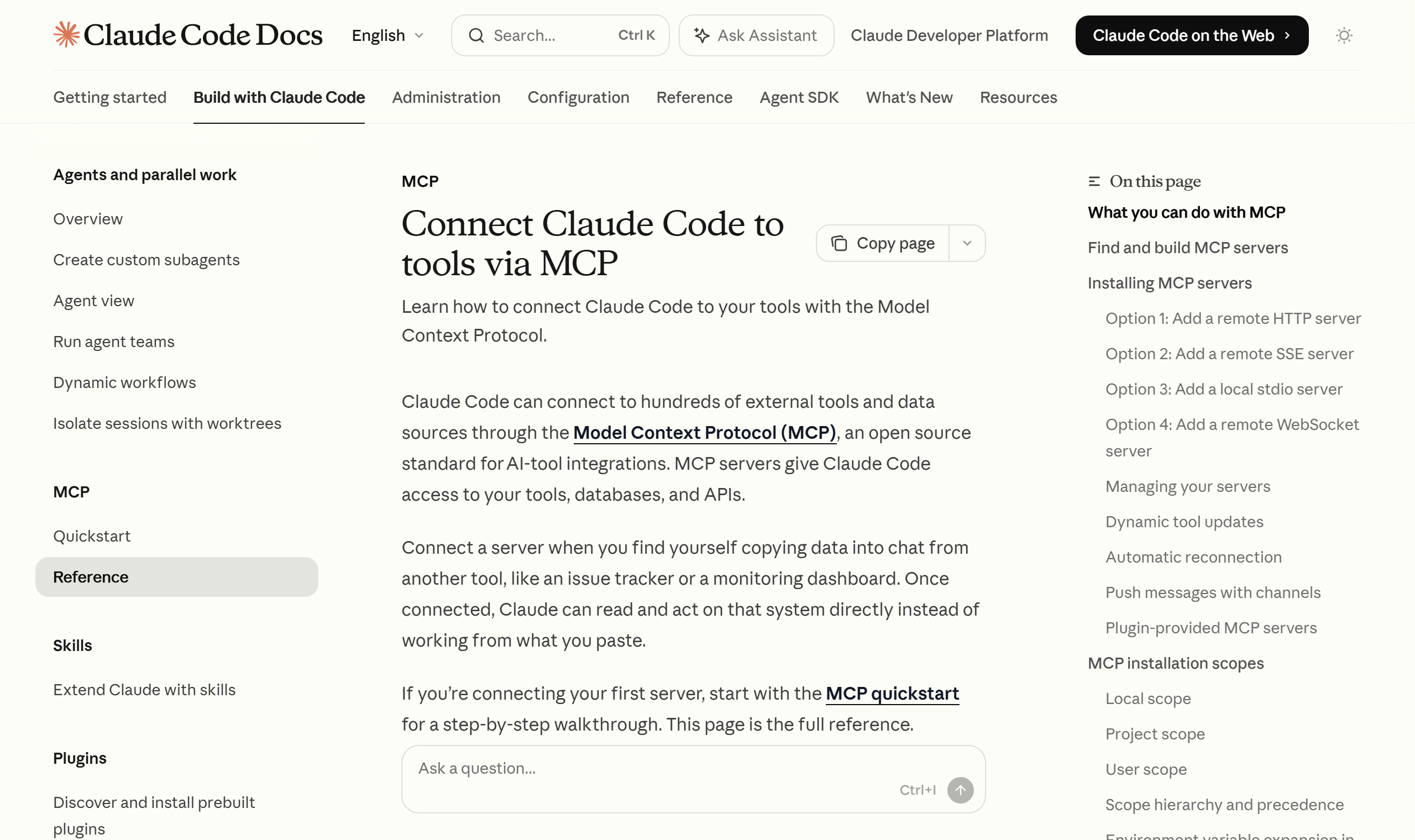
What Is MCP — a Common Connection Standard for AI
MCP is an open-source protocol that Anthropic released in November 2024. The official documentation (modelcontextprotocol.io) often likens it to “a USB-C port for AI applications.” Just as USB-C unified charger, monitor, and storage connections into a single connector, MCP standardizes the way AI apps connect to external systems into one spec.
There are broadly three things to connect to: data sources like files and databases, tools like search, computation, and API calls, and prompts (workflows) that encapsulate a specific task procedure. Instead of an AI agent approaching these three in a different way each time, it reads and executes them through one agreed-upon method called MCP.
The core value is “build it once, use it anywhere.” MCP is not a closed spec belonging to one company but an open protocol anyone can implement. So once you turn a tool into an MCP server, it can be reused as-is in Claude and in any other AI environment that adopts the same standard. From the tool provider’s side, you build the integration only once; from the AI app’s side, you just pick an existing server and plug it in.
Understanding the Structure — Host, Client, Server
MCP follows a client-server architecture. Splitting the roles into three makes it quick to grasp.
- MCP Host: The AI application the user faces directly. Like Claude Desktop or a coding agent, it orchestrates multiple connections.
- MCP Client: A connection component created one per server. It runs inside the host and communicates 1:1 with a server.
- MCP Server: The program that provides the actual context (data, tools, prompts). Servers exist per connection target — a Notion server, a GitHub server, and so on.
By analogy, the host is a power strip with several sockets, the client is each socket, and the server is the device that plugs into it. As long as the spec (MCP) between the strip and the device matches, any device works the moment you plug it in. This simple agreement is the heart of reducing the N×M integration hell to N+M.
The features a server provides are defined as standard primitives: tools (actions the agent can execute), resources (data it can read), and prompts (reusable task templates). The agent inspects which primitives a connected server exposes, then picks and calls the ones it needs.
Why It Became a Standard So Fast
Good technology doesn’t automatically become a standard. There are two reasons MCP took hold in such a short time.
First, timing. 2025–2026 was the period when AI agents that go beyond a simple chatbot to use tools directly came into their own. For an agent to be useful it has to reach external systems, and if each system’s connection method is ad hoc, the ecosystem won’t scale. MCP took precise aim at the sorest point — the “agent ↔ tool” connection.
Second, adoption by competitors. Although it is a standard Anthropic created, external reporting indicates that major AI vendors such as OpenAI, Microsoft, Google, and Amazon have added MCP support to their own products, cementing it as a de facto industry standard. A spec only its creator uses is not a standard; the moment competitors adopt the same spec, it becomes the de facto standard. With enterprise software players like Salesforce, ServiceNow, and Workday joining in as well, MCP is being widely embraced as the conduit for connecting in-house systems to AI.
The numbers that show the scale are striking too. By one tally, downloads of the related SDKs reach roughly 97 million per month, and publicly available MCP servers number in the thousands. That said, growth figures like these are often first- or second-hand tallies, so it is safer to read the direction — “it spread broadly in a short time” — than to fixate on exact absolute values.

What I Noticed After Plugging It In Myself
As I run the NABERAL automation pipeline, I have actually connected and operated several MCP servers. At first I copied and pasted reference material into the chat window every time, but the longer the volume grew, the more it lagged and the slower the work got. After I attached servers for the file system and document search over MCP, the agent read the data it needed on its own, and the “copy → paste → check again” loop shrank noticeably.
The second thing I felt was reusability. Once you organize a tool into an MCP server, other agent tasks can call the same server as-is. Compared with my old approach of rewiring the integration every time I built a new tool, even a like-for-like comparison of the same tool makes the operational burden clearly lighter.
Of course it isn’t a cure-all. Misconfigure server permissions and the agent risks reaching data it should never touch, so I had to make a habit of keeping the connection targets and permission scope narrow. It is clear that as much convenience as the standard delivers, the operator has to decide directly how far to open that convenience.
Where Is the 2026 Ecosystem Headed
The direction the official roadmap (modelcontextprotocol.io/development/roadmap) points to is “agent-to-agent connection.” If MCP has so far focused on linking agents to tools, the next step shifts the center of gravity toward multi-agent orchestration, where MCP servers call one another and several agents collaborate. Once the structure of one agent calling another like a tool is handled within the standard, workflow automation that divides a complex task by role becomes a good deal more natural.
Infrastructure like security, authentication, and a searchable server registry is also a major axis of the roadmap. Once servers number in the thousands, “which server do I trust and plug in” quickly becomes a real-world problem. The more this piece gets sorted out, the closer we get to an era where even non-developers connect vetted servers with a single click.
In short, MCP is a tool-neutral standard not bound to any particular model or company. Whatever AI you use, the way it connects to external systems shares the same spec. If you are a developer bringing AI agents into your work, getting a grip on the concept and structure of MCP now will serve as a lasting yardstick for your future tool choices.
Frequently Asked Questions
Q. Is MCP only used with Claude?
No. MCP was created by Anthropic but is an open standard, so it works across many AI apps and clients that adopt the same spec. Per external reporting, major vendors are adding support, so it is not tied to any single product.
Q. Do I have to build MCP servers myself?
Not necessarily. By one tally, publicly available MCP servers already number in the thousands, so for common connections like Notion, GitHub, or the file system you can just pick a ready-made server and plug it in. You only implement your own when there is no public server — for example, an in-house-only system.
Q. Is it secure?
Permission configuration matters more than the connection itself. The basics are to keep a tight scope on which data and tools the agent can reach, and safeguards like authentication and a registry keep getting reinforced in the official roadmap.
Sources: Model Context Protocol — Roadmap, Claude Docs — MCP, Wikipedia — Model Context Protocol, The New Stack — MCP Roadmap 2026