
GPT-5.6 in GitHub Copilot: Sol vs Terra vs Luna — Which Variant to Use (and When Claude Sonnet 5 Still Wins)
Quick answer: Pick Terra as your everyday default for interactive and agentic coding, reach for Sol when a large codebase or a long-running agentic task needs the highest reasoning ceiling, and drop to Luna when you want the lowest-cost, lightweight option. If your priority is a low per-token price for high-volume generation, Claude Sonnet 5 is still worth a direct comparison.
OpenAI’s GPT-5.6 landed in GitHub Copilot on July 9, 2026, and it did not arrive as one model. It arrived as three named variants — Sol, Terra, and Luna — each tuned for a different point on the cost-versus-capability curve. For anyone building agentic automation into their daily development, that choice now happens before you write a single prompt. This guide walks through what each variant is built for, how to match it to real work, and where Claude Sonnet 5 remains the stronger pick.
I run an automation pipeline that leans on GitHub Copilot every day, so I have had to make these variant decisions in practice rather than in theory. The framing below reflects how I actually route tasks.
Table of contents
- What are Sol, Terra, and Luna?
- Which variant should you use for large codebases?
- Which variant fits everyday agentic coding?
- How does GPT-5.6 compare to Claude Sonnet 5 on price?
- When does Claude Sonnet 5 still win?
- FAQ
What are Sol, Terra, and Luna?
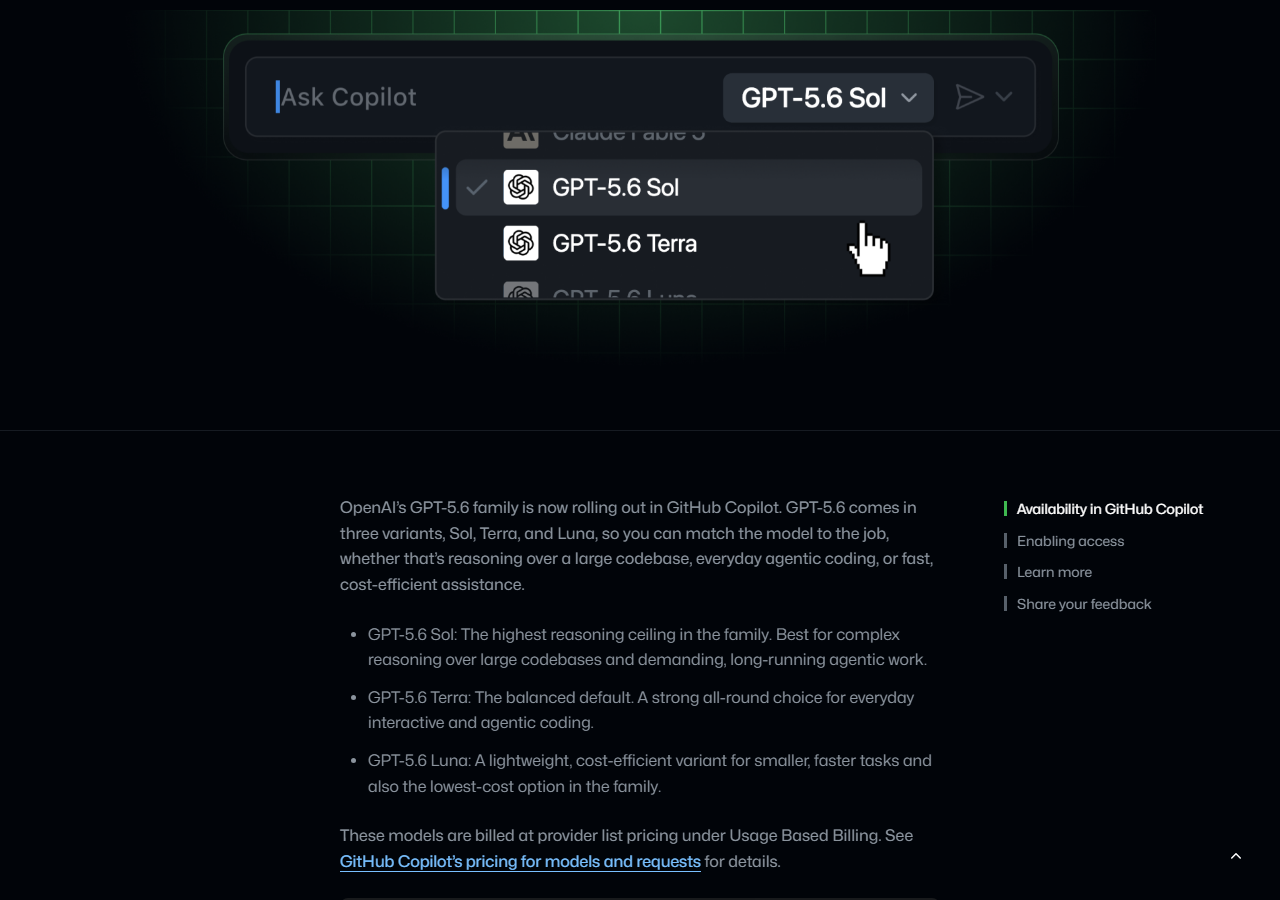
The three variants share the GPT-5.6 base but are positioned for different jobs. According to GitHub’s own changelog announcing the release, the split works like this:
- Sol carries the highest reasoning ceiling. It is aimed at large codebases and long-running agentic tasks, the kind of work where a model needs to hold a lot of context and reason through many steps without losing the thread.
- Terra is the balanced default. It targets everyday interactive and agentic coding, the requests most developers and creators make dozens of times a day.
- Luna is the lightweight, lowest-cost variant. It exists for situations where speed and price matter more than maximum depth.
One access detail is worth flagging early. Sol is available to Copilot Pro+, Max, Business, and Enterprise users, and it runs on usage-based billing. That pricing model changes how you should think about reaching for it, which I return to below.
Which variant should you use for large codebases?
Sol is the answer here, and the reasoning ceiling is why. When a task spans a large repository or runs as a long agentic sequence — refactoring across many files, tracing a bug through several layers, or letting an agent plan and execute multiple steps — the depth of reasoning matters more than raw speed. Sol is the variant OpenAI positioned for exactly that load.
In my own testing across our automation pipeline, I found the difference most obvious on multi-step agentic runs. A task that asked the agent to read several modules, propose a change, and then adjust it after checking the result held together noticeably better on Sol than on the lighter variants. That is consistent with how GitHub describes it, and it matches the intuition that a higher reasoning ceiling pays off when the problem is genuinely large.
The trade-off is cost. Because Sol runs on usage-based billing for Pro+, Max, Business, and Enterprise plans, leaving it selected for every trivial request can add up quickly. Treat Sol as a deliberate choice for heavy work, not a permanent default.
Which variant fits everyday agentic coding?
Terra. For the steady stream of interactive requests — writing a function, explaining a snippet, drafting a small refactor, running a routine agentic step — Terra is built to be the balanced default. It gives you enough capability for most workflow automation without pushing you toward Sol’s usage-based cost on tasks that do not need it.
Luna sits below Terra for the lightest jobs. When I am running high-volume, low-complexity generation where each individual call is simple, Luna’s lower cost makes it the sensible pick. The practical routing I settled on looks like this: Luna for cheap, simple, high-frequency calls; Terra for the everyday middle; Sol for the heavy, high-stakes runs. That three-tier habit keeps spend predictable while still giving hard tasks the reasoning they need.
How does GPT-5.6 compare to Claude Sonnet 5 on price?
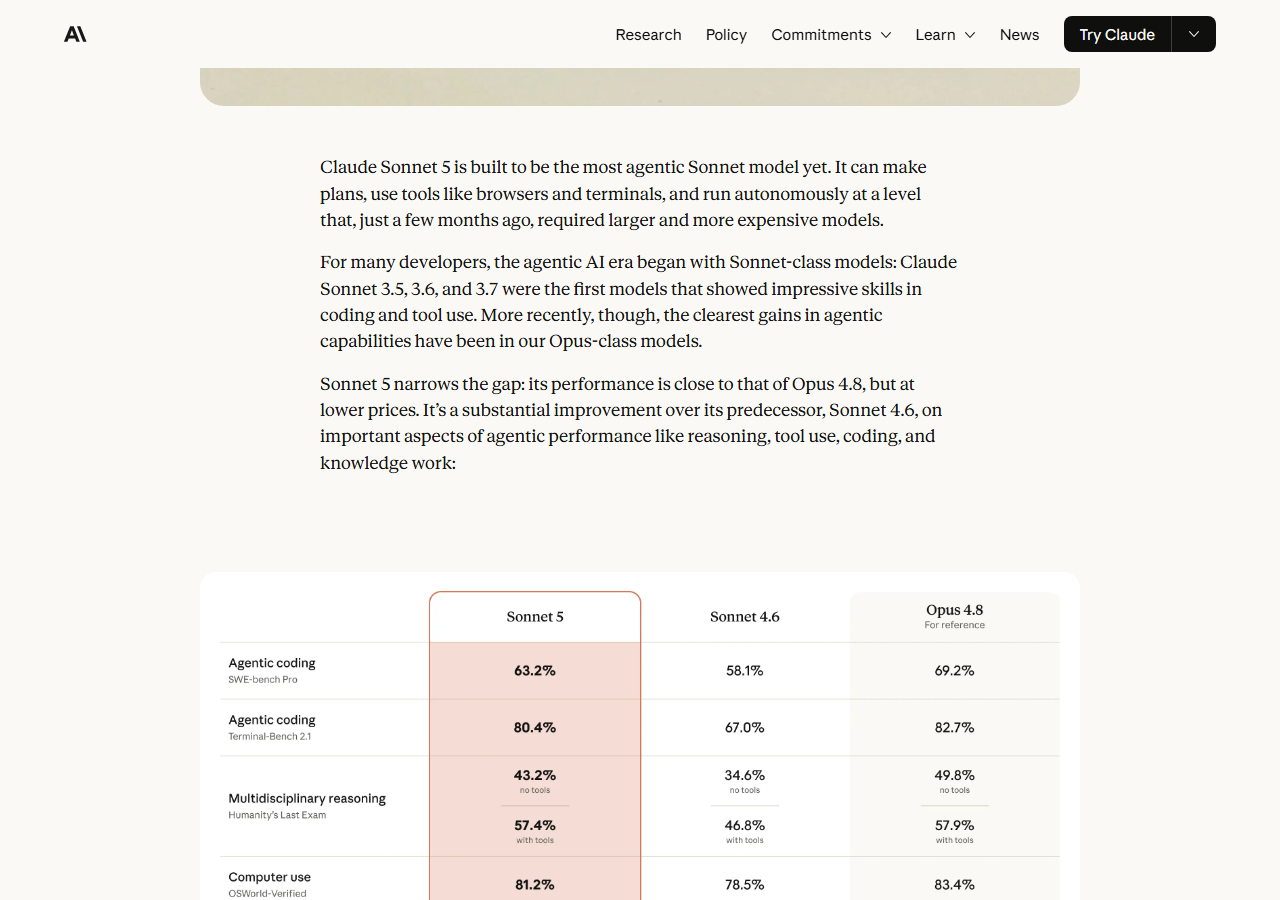
Price is where a cross-vendor comparison becomes concrete. Claude Sonnet 5, which Anthropic released on June 30, 2026, has a published, flat token price. Per Anthropic’s announcement, the introductory rate is $2 per million input tokens and $10 per million output tokens, and that introductory pricing holds through August 31, 2026. After that date, the standard rate moves to $3 per million input tokens and $15 per million output tokens.
That is a clean, predictable number you can put in a budget. GPT-5.6’s Sol variant, by contrast, is described in GitHub’s changelog as usage-based within the Copilot plans rather than as a flat published per-token rate, so the two are not a like-for-like comparison on a single figure. The honest takeaway: if you need a known per-million-token cost to forecast spend on high-volume generation, Sonnet 5’s transparent introductory pricing is easy to reason about. If you are working inside Copilot and want variants tuned specifically for agentic coding, GPT-5.6’s tiered lineup is built for that context.
When does Claude Sonnet 5 still win?
Three situations stand out for developers and creators weighing the two.
First, budget transparency. A flat, published token price makes cost modeling straightforward, especially for high-volume automation where every call counts.
Second, workflows already built around Anthropic’s models. If your existing workflow automation, tooling, and prompts are tuned for Sonnet-class models, the switching cost is real, and Sonnet 5’s introductory pricing gives you a strong reason to stay.
Third, the introductory window itself. Through August 31, 2026, the $2/$10 rate is a genuine discount against the later $3/$15 standard, so anyone doing heavy generation in that window has a clear pricing incentive.
None of this makes GPT-5.6 the wrong choice inside Copilot. The point is that “best model” depends on where you work and what you are optimizing for. In my pipeline I keep both available and route by task: Copilot’s variants for in-editor agentic automation, Sonnet 5 for high-volume batch work where the flat price wins. OpenAI and Anthropic are both moving fast, and keeping a foot in each has been the pragmatic call.
FAQ
Is Sol available on every Copilot plan?
No. Sol is available to Copilot Pro+, Max, Business, and Enterprise users, and it runs on usage-based billing.
What is the safest default if I do not want to think about it?
Terra. It is positioned as the balanced default for everyday interactive and agentic coding, which covers most requests without the usage-based cost profile of Sol.
What does Claude Sonnet 5 cost right now?
The introductory rate is $2 per million input tokens and $10 per million output tokens through August 31, 2026, then $3 per million input and $15 per million output afterward.
Should I switch entirely from one to the other?
Not necessarily. Routing tasks between GPT-5.6 variants inside Copilot and Sonnet 5 for flat-priced high-volume work is a reasonable strategy for developers and creators who use both OpenAI and Anthropic tooling.
Sources: GitHub changelog, “OpenAI’s GPT-5.6 Sol, Terra, and Luna are now available in GitHub Copilot” (2026-07-09) https://github.blog/changelog/2026-07-09-openais-gpt-5-6-sol-terra-and-luna-are-now-available-in-github-copilot/ · Anthropic, “Claude Sonnet 5” (2026-06-30) https://www.anthropic.com/news/claude-sonnet-5